Big Five personality traits
Updated on June 2, 2023
Why do people respond differently to the same situations? In contemporary psychology, the Big Five personality traits are five broad domains which define human personality and account for individual differences. This article tells you more about the Big Five personality theory and the personality traits it distinguishes. After reading it, take our free personality test to determine your own Big Five personality type.
History of Big Five personality theory
Several independent sets of researchers discovered and defined the five broad personality traits based on empirical, data-driven research. Ernest Tupes and Raymond Christal advanced the initial model, based on work done at the U.S. Air Force Personnel Laboratory in the late 1950s.1 J.M. Digman proposed his five factor model of personality in 19902, and Goldberg extended it to the highest level of organizations in 1993.3 In a personality test, the Five Factor Model or FFM4 and the Global Factors of personality5 may also be used to reference the Big Five traits.
Big Five personality traits
Human resources professionals often use the Big Five personality traits dimensions to help place employees. That is because these dimensions are considered to be the underlying traits that make up an individual’s overall personality.
The Big Five personality traits are:
- Openness
- Conscientiousness
- Extraversion
- Agreeableness
- Neuroticism
or OCEAN:
- Openness - People who like to learn new things and enjoy new experiences usually score high in openness. Openness includes personality traits like being insightful and imaginative and having a wide variety of interests.
- Conscientiousness - People that have a high degree of conscientiousness are reliable and prompt. Personality traits include being organized, methodic, and thorough.
- Extraversion - Extraverts get their energy from interacting with others, while introverts get their energy from within themselves. Extraversion includes the personality traits of energetic, talkative, and assertive.
- Agreeableness - These individuals are friendly, cooperative, and compassionate. People with low agreeableness may be more distant. Personality traits include being kind, affectionate, and sympathetic.
- Neuroticism - Neuroticism is also sometimes called Emotional Stability. This dimension relates to one’s emotional stability and degree of negative emotions. People that score high on neuroticism often experience emotional instability and negative emotions. Personality traits include being moody and tense for example.
Free Big Five personality test
Want to learn more about yourself and your strengths? Take a free Big Five personality test
To the personality testBig Five personality traits visually explained
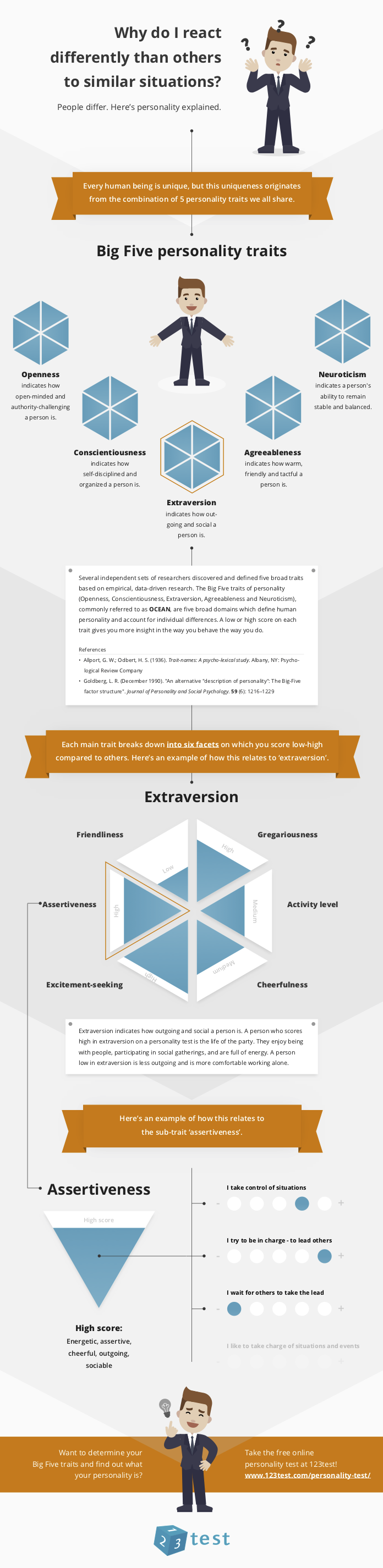
How to use results from the Big Five personality test
The Big Five personality test gives you more insight into how you react in different situations, which can help you choose an occupation. Career professionals and psychologists use this information in a personality career test for recruitment and candidate assessment.
What's your personality?
Find out more about you and your strengths.
Take a free big 5 personality testTest personality free
To determine your Big Five personality traits, take our free online personality test. It tells you more about yourself and what your strengths and weaknesses are. This personality test measures the Big Five personality factors developed over several decades by independent groups of researchers. It is the most scientifically validated and reliable psychological model to test personality. You can also take our career test to test personality.
Recommended books on personality
- Big Five Assessment: For students, researchers, and practitioners of psychology and related fields, a detailed guide to the various instruments that are used to evaluate the conventional Big Five personality factors. Authors: Boele De Raad & Marco Perugini
- Personality in Adulthood, Second Edition: A Five-Factor Theory Perspective: This influential work examines how enduring dispositions or traits affect the process of aging and shape each individual’s life course. Authors: Robert R. McCrae & Paul T. Costa Jr.
- The Five-Factor Model of Personality Across Cultures: The Five-Factor Model Across Cultures was designed to further an understanding of the interrelations between personality and culture by examining the dominant paradigm for personality assessment - the Five-Factor Model or FFM - in a wide variety of cultural contexts. Authors: Robert R. McCrae & Juri Allik
References
- 1 Tupes, E.C., Christal, R.E.; "Recurrent Personality Factors Based on Trait Ratings," Technical Report ASD-TR-61-97, Lackland Air Force Base, TX: Personnel Laboratory, Air Force Systems Command, 1961.
- 2 Digman, J.M., "Personality structure: Emergence of the five-factormodel," Annual Review of Psychology, 41, 417-440, 1990.
- 3 Goldberg, L.R., "The structure of phenotypic personality traits," American Psychologist, 48, 26-34, 1993.
- 4 Costa, P.T., Jr., McCrae, R.R.; Revised NEO Personality Inventory (NEO-PI-R) and NEO Five-Factor Inventory (NEO-FFI) manual. Odessa, FL: Psychological Assessment Resources, 1992.
- 5 Russell, M.T., Karol, D.; "16PF Fifth Edition administrator's manual." Champaign, IL: Institute for Personality & Ability Testing, 1994.